













Which sun protection should I choose for black, mixed-race, or dark skin?
Black, mixed-race, and olive skin also need daily sun protection. While their richness in melanin provides better natural protection against UV rays, it does not shield them from sunburn, skin aging, pigment spots, or damage caused by UVA rays.
Discover our 100% naturally derived sun protection, formulated to effectively protect all skin tones while offering a comfortable finish, without compromising on skin respect.
8 products


Nouveauté
SPF50+ Milky Sun Fluid
34€


Nouveauté
SPF30 Milky Sun Fluid
29€


-16%
Essential Summer Duo
49,90€
59,90€


Nouveauté
Summer beauty
50€


Nouveauté
Riviera Gift Set
77€


Nouveauté
Passion for the islands
66€


Nouveauté
Vanilla sugar nourishing scrub
28€

DID YOU KNOW?
Essentials for pigmented skin
- Moisturize your skin daily to preserve its radiance.
- Protect it from UV rays to limit dark spots.
- Avoid touching blemishes to prevent scarring.
- Prioritize gentle skincare that respects the skin barrier.
Frequently asked questions about sun protection for dark, mixed-race, and olive skin
Do black skins need sun protection?
Yes. Melanin provides greater natural protection than it does for light skin, but it does not block UV rays. UVA rays penetrate deep into the skin and contribute to skin aging, while UVB rays can cause sunburn and DNA damage. Sun protection is therefore still recommended for all skin tones.
Why do darker skin tones easily develop pigment spots?
Melanin-rich skin reacts more easily to inflammation, breakouts, friction, or sun exposure by producing more pigment. This post-inflammatory hyperpigmentation can persist for several months. Daily sun protection limits the worsening of these dark spots.
Which SPF should you choose for dark or mixed-race skin?
An SPF 30 is suitable for moderate daily sun exposure. For prolonged exposure, vacations, or time spent at the mountains or the beach, an SPF 50+ is recommended to limit UV-related damage and prevent pigment disorders.
Can black skin get sunburned?
Yes, even if it is less common. Sunburns do occur on dark skin, but they can be harder to recognize because the redness is less visible. A feeling of heat, pain, or tenderness may be the first sign of a sunburn.
Do black skins age more slowly?
Melanin-rich skin generally shows fewer premature sun-related wrinkles thanks to better natural UV protection. However, it is not protected against UVA-induced aging, nor against cellular damage or pigmentary disorders.
Where does the slight bluish halo of mineral sunscreens come from, and why is it more or less visible depending on the skin type?
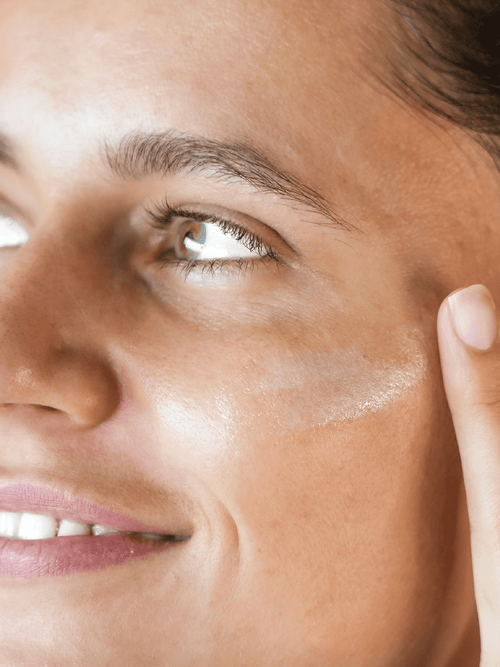
Mineral filters provide protection by diffusing light through an optical phenomenon (the Tyndall effect, the same one that makes the sky blue); fine particles reflect slightly more blue wavelengths, resulting in a very subtle cool-toned veil. Its visibility depends not on the depth of the complexion, but on its undertone: on a cool complexion (rosy), this halo blends in and becomes almost invisible. On a warm complexion (golden, olive, coppery), the blue contrasts more, which can create a slightly ashy effect. This is why the finish varies so much from one person to another, even between two fair skin tones or two dark skin tones. Our milky sunscreen fluids minimize this phenomenon as much as possible thanks to a new-generation zinc oxide and optimized dispersion, but the finish will be invisible on cool undertones, while warm undertones may have a slight bluish halo.
Does a mineral sunscreen inevitably leave white casts?
No. Older generations of mineral filters were often very whitening. Today, the quality of pigment dispersion and the formulation process make it possible to obtain much more discreet textures. At La Canopée, our sun fluid has been formulated to provide comfortable application and minimize the white cast as much as possible, even on darker skin tones.
Should sunscreen be applied every day?
Yes, as soon as the skin is exposed to daylight, particularly in spring and summer or during prolonged exposure. UVA rays pass through clouds and glass and contribute to skin aging as well as the appearance of dark spots.
How to properly apply your sunscreen?
Apply your sun protection generously as the final step of your skincare routine, before makeup. Reapply every two hours in case of continuous exposure, as well as after swimming, heavy sweating, or towel drying.