














Black, mixed-race, or olive skin: what does the sun really do, and how can you protect yourself properly?
We still hear it too often: "When you have dark skin, you don't need sunscreen." This is one of the most persistent myths in cosmetics and one of the easiest to debunk. Melanin is a true ally, but it has its limits, and above all, the number one issue for melanin-rich skin is not sunburn. It is dark spots. We explain the core of the matter, with scientific sources to back it up.
Why trust us:
We have been at the heart of green chemistry innovation for nearly 10 years.
Over 50,000 customers have trusted us since the beginning on this site, and we are a testament to their loyalty.
As passionate experts, we closely follow all advances in botany, cosmetics, and also dermatology.
Table of Contents
against the sun? A quick reminder: UVB, UVA… and visible light Why is dark skin more
prone to dark spots? Does the sun also pose a cancer risk for dark skin? How to properly protect black,
mixed, or tanned skin? Which SPF to choose? Do our milky sun fluids leave a white cast on tanned to dark skin? The right application techniques And after the sun? The nourishing step
we often forget In summary FAQ Sun protection and dark skin To take good care of your skin!
Does melanin really protect
against the sun?
Yes, but much less than you might think. Melanin is the pigment that gives skin its color; the more of it there is, the more it absorbs some of the ultraviolet rays. This natural protection is real. The problem is its intensity; the darkest skin offers the equivalent of an SPF of about 13, well below the SPF 30 to 50 recommended by dermatologists for effective protection.
In other words, melanin filters some of the radiation, but lets enough UV through to cause damage. Sunburn is therefore possible on black and mixed-race skin; it is simply less visible and often underestimated.
A quick reminder: UVB, UVA… and visible light
To understand the rest, three players must be distinguished:
UVB rays cause sunburn and contribute to skin cancers. Melanin filters them quite well.
UVA rays penetrate more deeply; they are involved in skin aging and, crucially here, in pigmentation.
Visible light (the light our eyes perceive, emitted by the sun but also by screens and lighting) has long flown under the radar. Yet, on melanin-rich skin, it triggers a darker and longer-lasting pigmentation than that induced by UVA.
It is this recent discovery that has changed the game for dark skin.
Why is dark skin more
prone to dark spots?
Because their melanocytes, the cells that produce pigment, are more reactive. On melanin-rich skin, the slightest irritation (pimple, ingrown hair, shaving, insect bite, friction) can leave a brown mark; this is post-inflammatory hyperpigmentation. Add the sun, and this reaction spirals out of control.
In concrete terms, exposure without protection is the main aggravating factor, and sometimes a trigger, for dark spots, pregnancy mask (melasma), and marks left by blemishes. Where light skin will mostly get a sunburn, dark skin will primarily develop dark spots and uneven skin tone. This is the number one aesthetic concern reported for these complexions.

And this is where the role of visible light makes sense; since UVB rays are fairly well filtered by melanin, a large part of the sun-induced pigmentation on dark skin comes from UVA and visible light. A sunscreen designed for these skin types must therefore be broad-spectrum.
Does the sun also pose a cancer risk for dark skin?
The risk of skin cancer is lower on dark skin than on light skin, but it is not zero, and it is often diagnosed later, and therefore at a more advanced stage. Furthermore, carcinomas (basal cell and squamous cell) are on the rise. Photoprotection therefore remains justified for all phototypes, including the darkest ones.
The message is not to scare anyone, but simply to remind us that no skin is "immune" to the sun.
How to properly protect black,
mixed, or tanned skin?
The good news is that the rules are simple, and a well-thought-out routine makes a visible difference to the complexion. Here is what the dermatological literature supports.
Which SPF to choose?
A minimum of SPF 30 for daily use, and SPF 50+ in case of intense exposure (beach, mountains, water sports) or when the skin is already prone to dark spots. In all cases, choose a broad-spectrum sunscreen that protects against both UVB and UVA rays.
This is exactly the logic behind our range: the SPF 30 milky sun fluid for everyday protection—the one we most often forget, even though it is the most decisive in the long term—and the SPF 50+ milky sun fluid for high-sunshine days and skin that marks easily. Their fluid, milky texture was designed to blend in and be applied easily without feeling heavy, a real issue for those with dark complexions.

Do our milky sun fluids leave a white cast on tanned to dark skin?
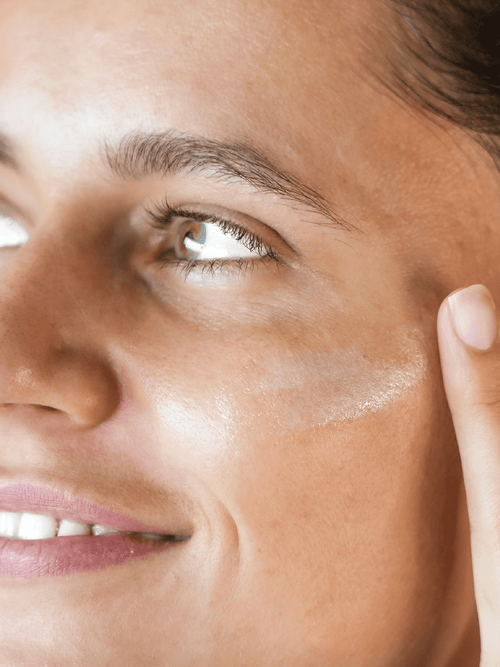
This is the number one obstacle for sunscreens on dark skin and is precisely the challenge that guided our entire formulation. Mineral filters have a natural tendency to leave white traces. By selecting a high-quality, new-generation zinc oxide and optimizing its dispersion, we have obtained a much more acceptable halo and no noticeable white cast. Mission accomplished!
Our SPF30 and SPF50+ Milky Sun Fluids are easy to apply while maintaining the effectiveness of a 100% mineral filter. A naturally derived sunscreen that finally combines effectiveness, sensoriality, and pleasure of use for all skin tones.
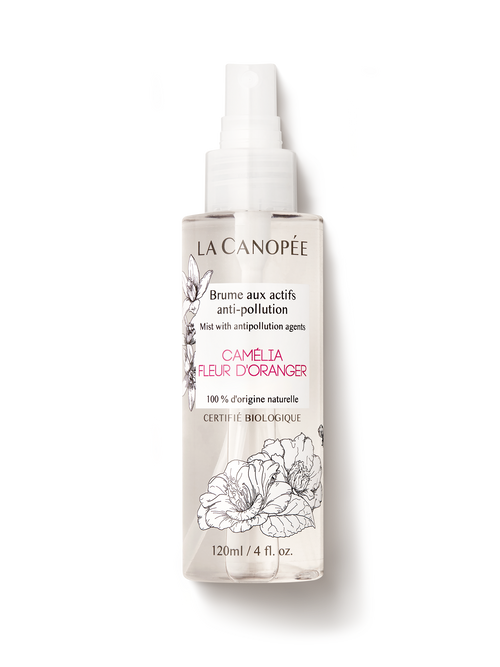
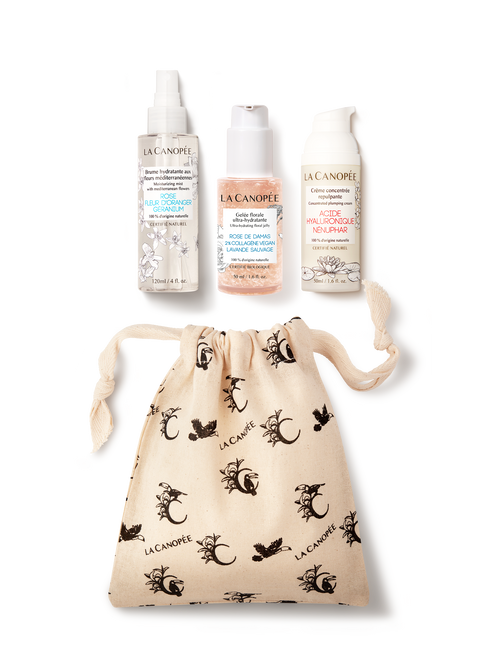
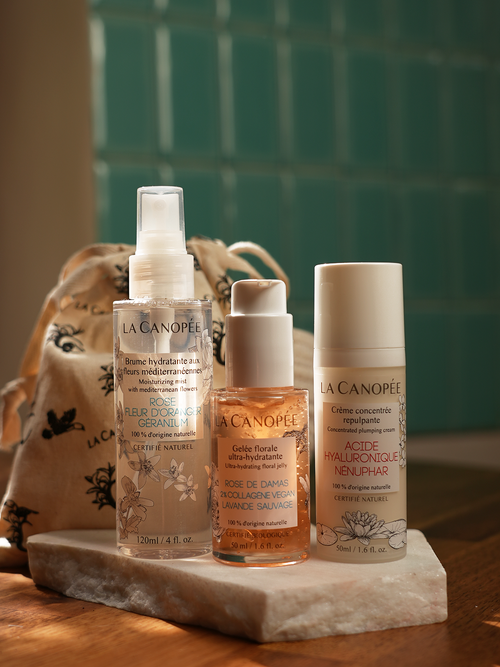
Good to know: the oily phase that ensures water resistance can, depending on the skin, provide a more or less luminous finish, which stabilizes a few minutes after application. For combination to oily skin, you can prep your face with a mist and then our ultra-hydrating floral jelly before applying the fluid, and lightly dust with powder to mattify if needed.
Proper application techniques
Whether using La Canopée sunscreens or another brand, effectiveness also depends on how you apply it:
Apply a sufficient quantity each morning as the final step of your skincare routine.
Reapply every 2 hours if exposed to the sun, and after swimming or heavy perspiration.
Don't forget frequently neglected exposed areas such as the ears, the back of the neck, the backs of the hands, the lips, and the feet.
And after sun exposure? The essential
nourishing step people forget
After sun exposure, your skin is thirsty. It feels tight, rougher, and sometimes uncomfortable—a sensation often more pronounced on dark skin, which is naturally more prone to dryness and a dull-looking complexion. The after-sun step is not a luxury; it is what helps maintain comfort and radiance.
This is the role of our Rich Coconut Milk, with its nourishing and enveloping texture designed to soothe discomfort and comfort the skin after sun exposure. On the skin, the milk melts like a light balm, leaving a satin, hydrated, and comfortable finish with a green, milky coconut scent that lingers a little longer. Nourished, comforted, and more radiant skin. On dark skin tones, light makes all the difference.
This is the role of our Rich Coconut Milk, with its nourishing and enveloping texture designed to soothe discomfort and comfort the skin after sun exposure.
On the skin, the milk melts like a light balm, leaving a satin, hydrated, and comfortable finish with a green, milky coconut scent that lingers a little longer.
Nourished, comforted, and more radiant skin. On dark skin tones, light makes all the difference.

In summary
Melanin provides some protection, but not enough (the equivalent of SPF ≈ 13). For black, mixed-race, and olive skin, the real challenge in the sun is dark spots and hyperpigmentation, largely caused by UVA rays and visible light. The solution involves three steps: a daily SPF 30 (SPF 50+ during exposure), a texture you love wearing so that you actually apply it, and after-sun nourishment to maintain comfort and radiance. No skin is immune, but every skin can be well supported.
FAQ: Sun protection and dark skin tones
Do black skin tones need sunscreen?
Yes. Melanin only offers protection equivalent to an SPF of about 13, which is insufficient to prevent sun damage, and especially hyperpigmentation. A broad-spectrum SPF 30 to 50+ is still recommended.
Can you get a sunburn with a dark skin tone?
Yes, it is possible, even if it is less frequent and less visible than on fair skin. However, deep damage linked to UVA rays often goes unnoticed.
What SPF is needed for mixed or olive skin?
SPF 30 minimum for daily use, SPF 50+ in case of intense exposure or for skin prone to dark spots, always with broad-spectrum UVA/UVB protection.
Does sunscreen help with dark spots?
Broad-spectrum sun protection (as provided by zinc oxide) applied daily helps limit the appearance and worsening of sun-related dark spots. For existing dark spots, a dermatological consultation is recommended.
Where does the light bluish halo of mineral sunscreens come from, and why is it more or less visible on different skin tones?
Mineral filters protect by diffusing light through an optical phenomenon (the Tyndall effect, which makes the sky look blue). The fine particles reflect slightly more blue wavelengths, creating a very slight cool veil. Its visibility depends not on the depth of the complexion but on its undertone: on a cool (pinkish) undertone, this halo blends in and becomes almost invisible. On a warm (golden, olive, copper) undertone, the blue contrasts more and can create a slightly ashy effect. This is why the finish varies so much from one person to another, including between two fair skin tones, or between two dark skin tones. Our milky sunscreen fluids minimize this phenomenon as much as possible thanks to a new-generation zinc oxide and optimized dispersion, but cool undertones will have an invisible finish, while warm undertones may have a slight bluish halo.
To properly take care of your skin!

Juliette Munoz,
Co-founder, in charge of communications at La Canopée.
✔️ Holds a Master's degree in design and environments.
✔️ Certified in aromatherapy.
✔️ Trained in facial massage and face yoga.
Passionate about skin biology, botany, and holistic beauty, Juliette founded La Canopée in 2017 alongside her sister Cécile, an expert in green chemistry. Driven by a commitment to her customers, Juliette tirelessly pursues excellence in all aspects of La Canopée, aiming to provide the best possible experience with the brand.